Tapescript
Recorded in one language, read in yours
A lecture in Spanish, a client call in German, a voice note from your aunt in Urdu. Tapescript writes it down in the language it was spoken in, then translates the whole note into the one you read best.

No account to make. Your notes stay in your own iCloud.
Tapescript is made for iPhone and iPad (iOS 18 or later). Open this page on your iPhone to get it.
Japanese class: the basics of keigo
We learned the difference between the three kinds of keigo: sonkeigo, kenjōgo and teineigo. There’s a short quiz next week.
Key points
- Keigo comes in three kinds: sonkeigo (respectful), kenjōgo (humble) and teineigo (polite).
- “Irassharu” is the respectful form of “iru”, “kuru” and “iku”.
- “Mōsu” is the humble form of “iu”.
A Japanese class, read in English
A 30-minute keigo class is written up in Japanese, in Japanese script. Lost the thread on a point? Translate the note into English, and the summary, the homework and the transcript all change together.
A switch under the title moves between the two, and both stay with the note.
日本語クラス:敬語の基本
30 min · Japanese
尊敬語・謙譲語・丁寧語の三つの違いを学びました。来週は小テストがあります。
- 敬語には尊敬語・謙譲語・丁寧語の三種類がある。
- 「いらっしゃる」は「いる・来る・行く」の尊敬語。
- 「申す」は「言う」の謙譲語。
An English lecture, read in Spanish
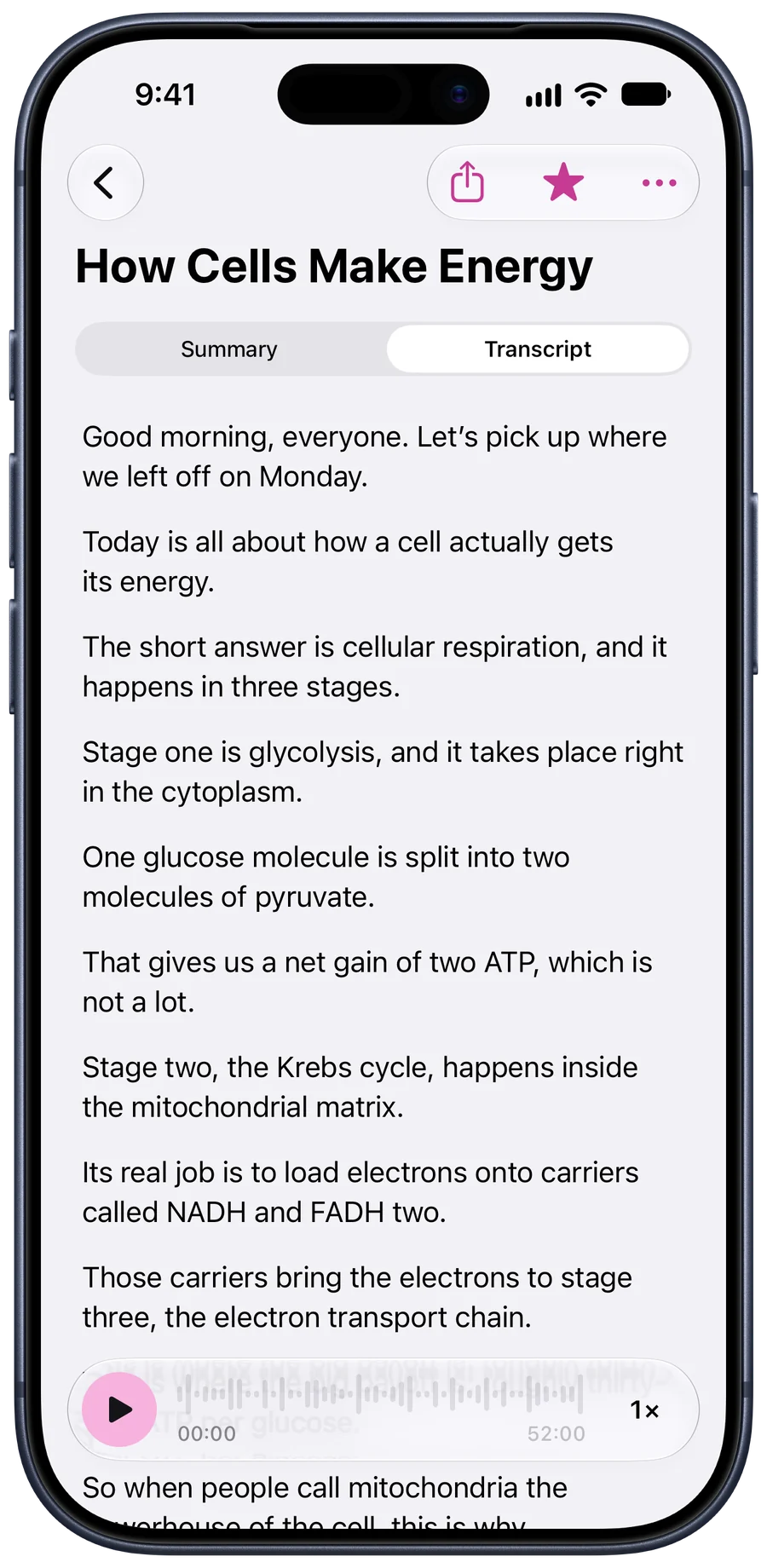
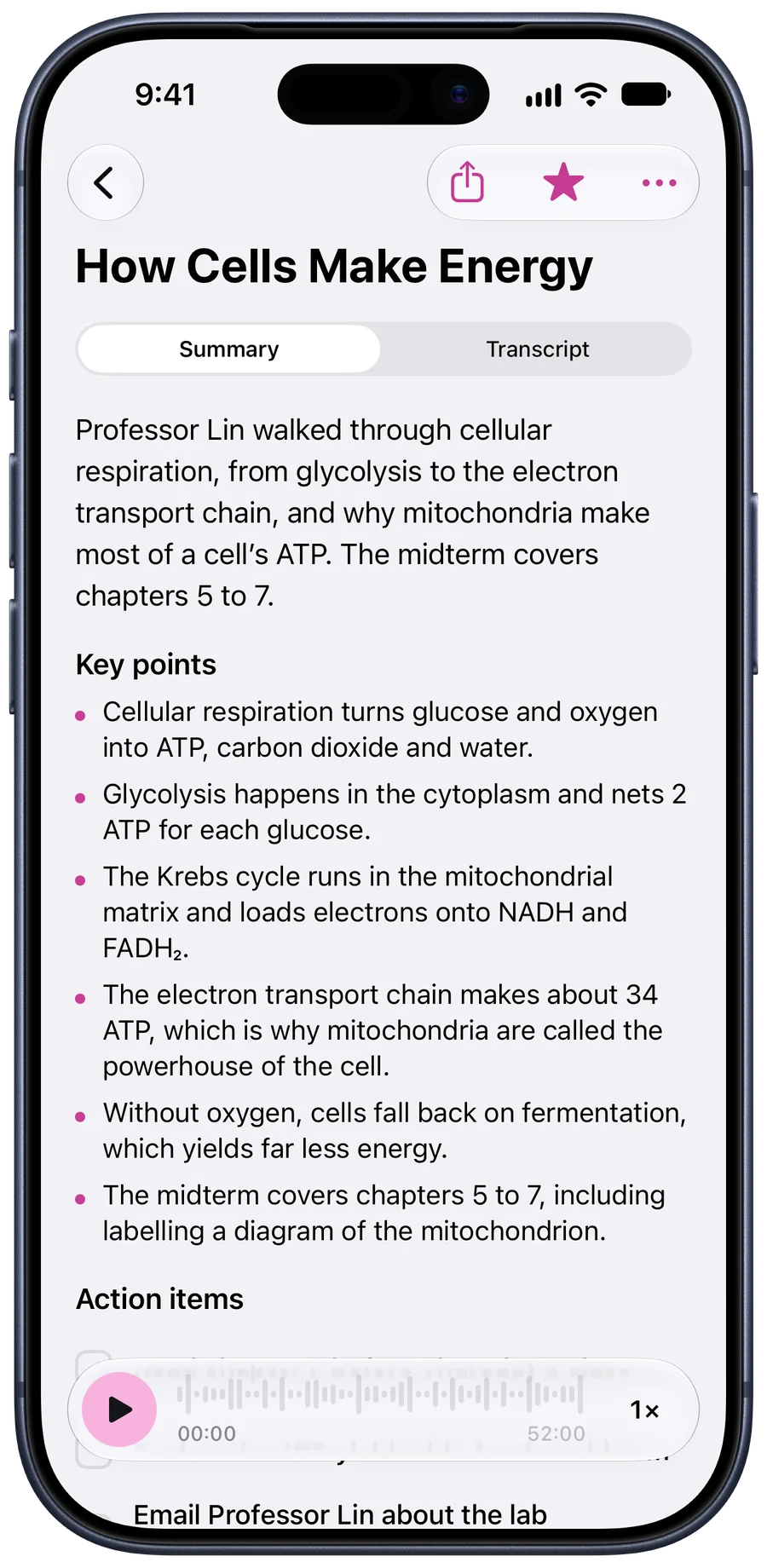
It works the other way just as well: Professor Lin’s biology lecture, given in English, read in Spanish by a student who thinks in Spanish. The ATP numbers and the midterm chapters come through as they were said.
Cómo obtienen energía las células
La profesora Lin explicó la respiración celular, desde la glucólisis hasta la cadena de transporte de electrones, y por qué las mitocondrias producen la mayor parte del ATP de la célula. El parcial cubre los capítulos 5 a 7.
Key points
- La respiración celular convierte glucosa y oxígeno en ATP, dióxido de carbono y agua.
- La glucólisis ocurre en el citoplasma y deja un saldo de 2 ATP por cada glucosa.
- El ciclo de Krebs tiene lugar en la matriz mitocondrial y carga electrones en el NADH y el FADH₂.
Share it in either language
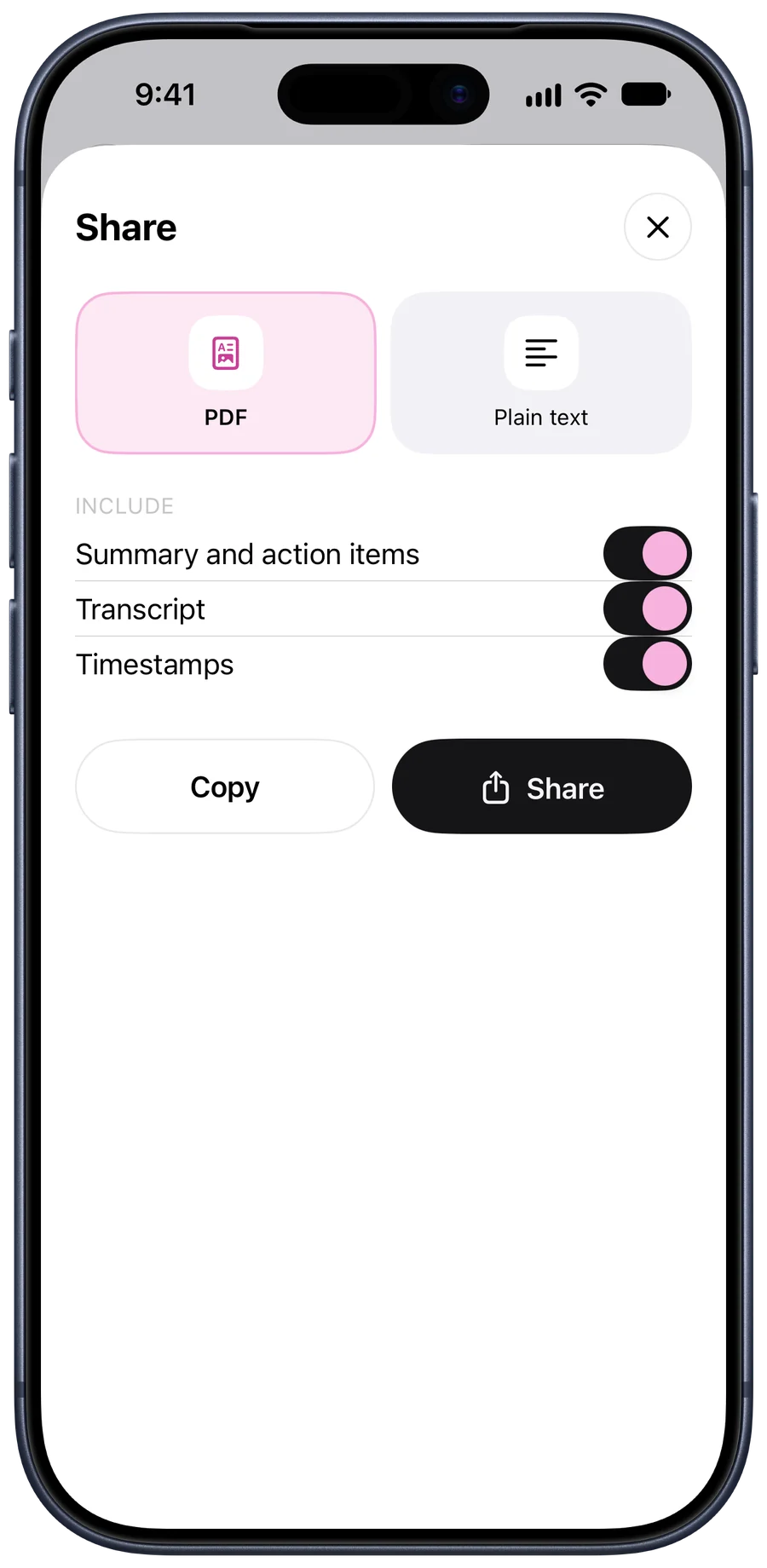
Share a note as a PDF or plain text and it goes in the language on screen. Send the Spanish to one person and the original to another.
Search finds words in the translation as well as in the original.
How it works
- Record in the language spoken. Choose it before you record or import, so the transcript is right before anything is translated.
- Then translate. When a note isn’t in your phone’s language, the app offers to translate it right under the title. Every other language is in the note’s menu.
- The original stays. Switch back with one tap, whenever you like.
- One translation a note. Translate into a new language and it takes the place of the last translation. The original is never touched.
The longer version: recording language classes.
Questions people ask
Can Tapescript translate audio?
Yes. It transcribes the recording in the language spoken, then translates the note (summary, key points, action items and transcript) into any of over 60 languages.
Which languages can it translate between?
Any two of the more than 60 it writes, among them Spanish, French, German, Portuguese, Arabic, Hindi, Urdu, Bengali, Persian, Turkish, Russian, Japanese, Korean and Chinese.
Is it live translation?
No. It translates the note once the recording has been written down, not while someone is speaking.
Does the translated transcript keep its timestamps?
Usually. Each translated line keeps the time of the line it came from, so tapping it still plays that moment of the recording. When a translation can’t be lined up with the original, its text shows on its own.
Can I translate a recording I made somewhere else?
Yes. Import the audio or video file, or share it to Tapescript from another app, and translate the note once it’s written.
Any language, read in yours.
Put your phone down at your next lecture or meeting, and pick up the notes when it ends.
Made for iPhone and iPad. Open this page on your iPhone to get it.
- No account
- Notes in your iCloud
- Translate into 60+ languages
- iPhone and iPad